GoCar - GPS Guided Tours
- English
- Castellano
- Italiano
- Français



PARK GÜELL
The park was originally part of a commercially unsuccessful housing site, the idea of Count Eusebi de Güell, whom the park was named after. It was inspired by the English garden city movement; hence the original English name Park. The site was a rocky hill with little vegetation and few trees, called Muntanya Pelada (Bare Mountain). It already included a large country house called Larrard House or Muntaner de Dalt House, and was next to a neighbourhood of upper class houses called La Salud. The intention was to exploit the fresh air (well away from smoky factories) and beautiful views from the site, with sixty triangular lots being provided for luxury houses. Count Eusebi Güell added to the prestige of the development by moving in 1906 to live in Larrard House. In the event only two houses were built, neither designed by Gaudí. One was intended to be a show house, but on being completed in 1904 was put up for sale, and as no buyers came forward. Gaudí, at Güell's suggestion, bought it with his savings and moved in with his family and his father in 1906. It has since been converted into a municipal garden.
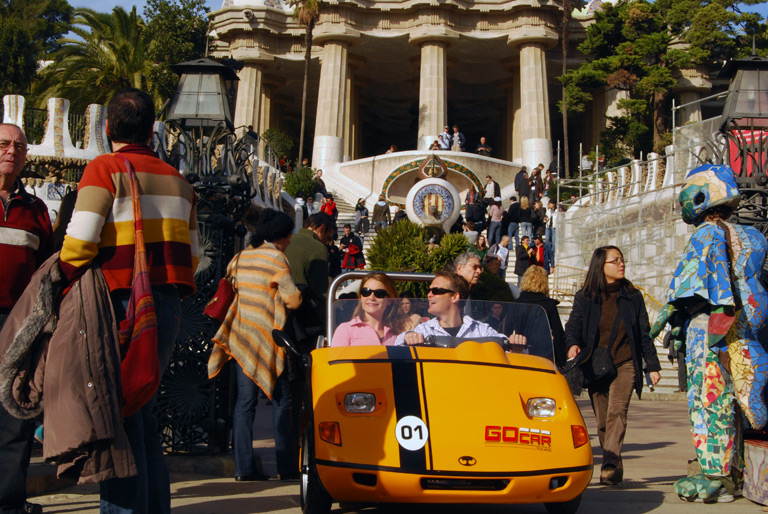
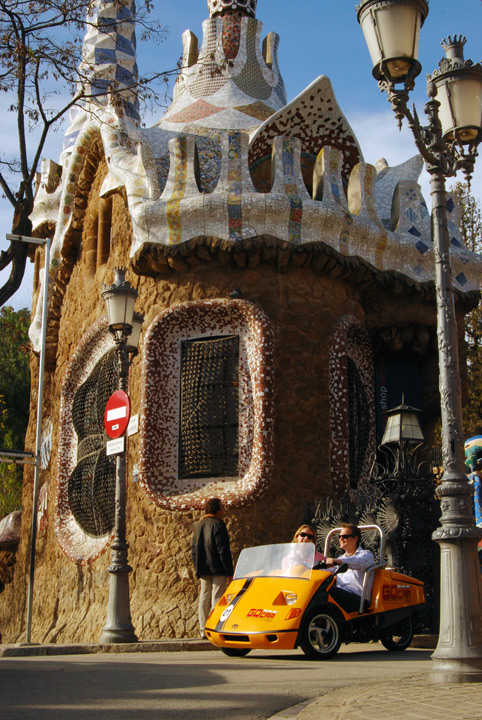
Although it sounds unlikely, the place is skilfully designed and composed to bring the peace and calm that one would expect from a park. The buildings flanking the entrance, though very original and remarkable with fantastically shaped roofs with unusual pinnacles, fit in well with the use of the park as pleasure gardens and seem relatively inconspicuous in the landscape when one considers the flamboyance of other buildings designed by Gaudí.
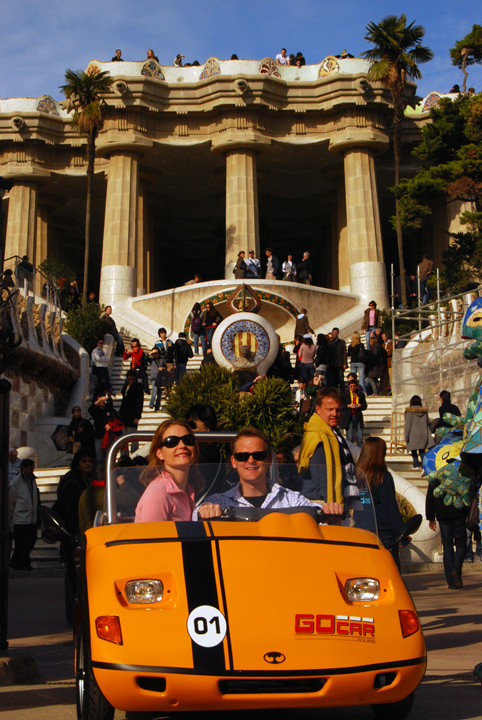
The focal point of the park is the main terrace, surrounded by a long bench in the form of a sea serpent. To design the curvature of the bench surface Gaudí used the shape of buttocks left by a naked workman sitting in wet clay!
The curves of the serpent bench form a number of enclaves, creating a more social atmosphere. Gaudí incorporated many motifs of Catalan nationalism, and elements from religious mysticism and ancient poetry, into the Park. The visitor was originally greeted by two life-size mechanical gazelles (a major euphemistic symbol of 'the young beloved' in the Hebrew strand of the medieval love poetry of the region), but these have since been lost during the turbulence of war.

Go back to the interactive map or choose another tour highlight
Mirador de Colom |
Camp Nou |